Exam C_ADBTP_2601 Cram Questions - Customizable C_ADBTP_2601 Exam Mode
Wiki Article
The world is a stage. We must seize all opportunities for career progression and to actualize our dream. So, you must seize PDFDumps to undersell yourself in the future. PDFDumps SAP C_ADBTP_2601 study guide will help you to overcome difficulties and to get the certification. We will help you to understand the laws of C_ADBTP_2601 Exam. PDFDumps provides original questions and pdf real questions and answers. If you get the certification, you will rise to undreamed-of heights.
The precision and accuracy of PDFDumps’s dumps are beyond other exam materials. They are time-tested and approved by the veteran professionals who recommend them as the easiest way-out for C_ADBTP_2601 certification tests. C_ADBTP_2601 Exam Materials constantly updated by our experts, enhancing them in line with the changing standards of real exam criteria. Therefore, our C_ADBTP_2601 dumps prove always compatible to your academic requirement.
>> Exam C_ADBTP_2601 Cram Questions <<
2026 Authoritative 100% Free C_ADBTP_2601 – 100% Free Exam Cram Questions | Customizable C_ADBTP_2601 Exam Mode
The features of the C_ADBTP_2601 dumps are quite obvious that it is based on the exam pattern. As per exam objective, it is designed for the convenience of the candidates. This content makes them expert with the help of the C_ADBTP_2601 practice exam. They can get C_ADBTP_2601 exam questions in these dumps. Old ways of teaching are not effective for C_ADBTP_2601 Exam Preparation. In this way students become careless. In our top C_ADBTP_2601 dumps these ways are discouraged. Now make the achievement of C_ADBTP_2601 certification easy by using these C_ADBTP_2601 exam questions dumps because the success is in your hands now.
SAP Administrating SAP Business Technology Platform(C_ADBTP_2601) Sample Questions (Q10-Q15):
NEW QUESTION # 10
SIMULATION
Establish Shared Services
Task 1: Create a Shared Services Directory and Subaccounts
In your SAP BTP cockpit, create the directory Shared Services (Description: Shared Accounts) with your global account as the parent.
In the Shared Services directory, create the subaccount SH Dev (Description: Shared Services Development) with subdomain btpops####-sh-dev in the region Amazon Web Services (AWS) → Europe (Frankfurt) cf-eu10.
In the Shared Services directory, create the subaccount SH Ops (Description: Shared Services Operations) with subdomain btpops####-sh-ops in the region Amazon Web Services (AWS) → Europe (Frankfurt) cf-eu10.
Answer:
Explanation:
See the Explanation below for complete solution.
Explanation:
Before You Start
Log in to the SAP BTP Cockpit.
Open the correct Global Account.
Make sure you are working in the correct global account before creating anything.
Why this matters:
The new directory and both subaccounts must be created inside the correct global account hierarchy.
Part A - Create the Shared Services Directory
Step 1 - Open Directories
What to do
In the SAP BTP Cockpit, open your Global Account.
In the left navigation menu, click Directories.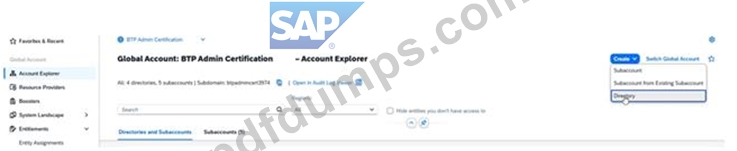
Explanation:
This is where you create and manage directory structures under the global account.
What to verify
You should now see the list of existing directories.
Step 2 - Create the Directory Shared Services
What to do
Click Create or Create Directory.
Enter the following values:
Name: Shared Services
Description: Shared Accounts
Parent: your Global Account
Click Create.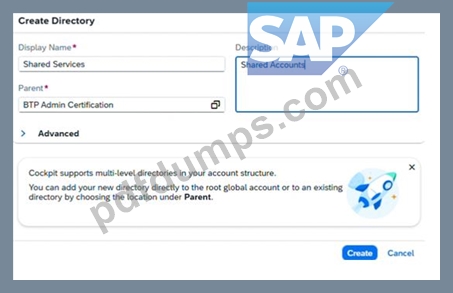
Explanation:
This creates a new top-level directory directly under the global account.
It will be used to hold the shared-services subaccounts.
What to verify
You should now see:
Shared Services
under the global account.
Part B - Create the SH Dev Subaccount
Step 3 - Open the Shared Services Directory
What to do
In the directory list, select Shared Services.
Explanation:
Both required subaccounts must be created inside this directory.
What to verify
You should now be inside the Shared Services directory.
Step 4 - Open Subaccounts
What to do
Inside Shared Services, open Subaccounts.
Click Create → Subaccount.
Explanation:
This opens the subaccount creation screen.
Step 5 - Create SH Dev
What to do
Enter the following:
Display Name / Name: SH Dev
Description: Shared Services Development
Subdomain: btpops####-sh-dev
Set the region as:
Cloud Provider: Amazon Web Services (AWS)
Region: Europe (Frankfurt)
Technical Region / Environment: cf-eu10
Then click Create.
Explanation:
This creates the shared services development subaccount in the required AWS Frankfurt region.
What to verify
After creation, you should see:
SH Dev
inside the Shared Services directory.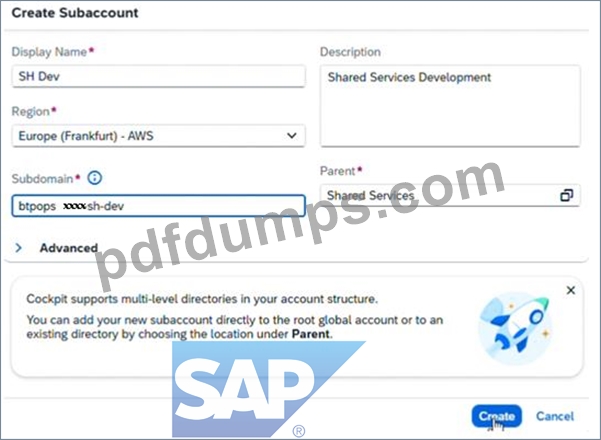
Part C - Create the SH Ops Subaccount
Step 6 - Start a New Subaccount
What to do
Still inside Shared Services, click Create → Subaccount again.
Explanation:
This opens the form for the second required subaccount.
Step 7 - Create SH Ops
What to do
Enter the following:
Display Name / Name: SH Ops
Description: Shared Services Operations
Subdomain: btpops####-sh-ops
Set the region as:
Cloud Provider: Amazon Web Services (AWS)
Region: Europe (Frankfurt)
Technical Region / Environment: cf-eu10
Then click Create.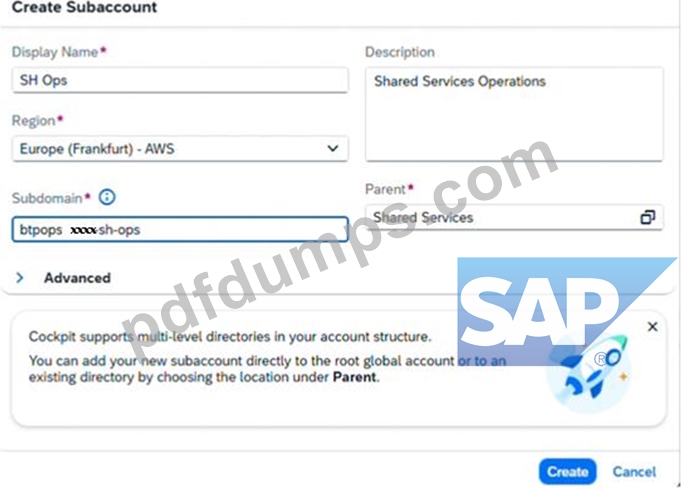
Explanation:
This creates the shared services operations subaccount in the same required region.
What to verify
After creation, you should see:
SH Ops
inside the Shared Services directory.
Final Expected Result for Task 1
You should now have:
Directory
Shared Services
Description: Shared Accounts
Parent: Global Account
Subaccounts inside Shared Services
SH Dev
Description: Shared Services Development
Subdomain: btpops####-sh-dev
Region: AWS → Europe (Frankfurt) cf-eu10
SH Ops
Description: Shared Services Operations
Subdomain: btpops####-sh-ops
Region: AWS → Europe (Frankfurt) cf-eu10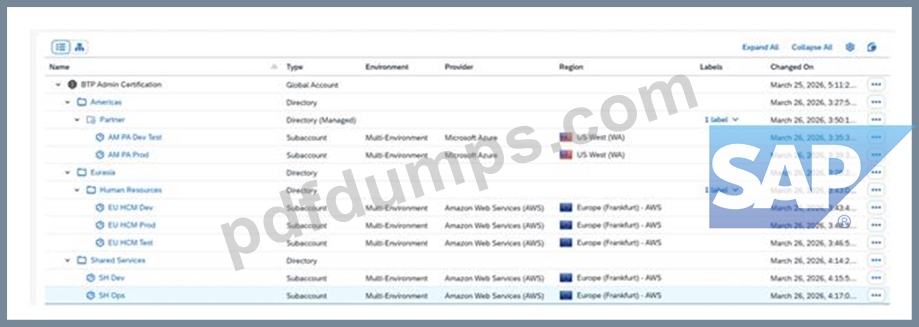
Common Mistakes to Avoid
1. Creating the directory in the wrong place
Shared Services must be created with:
parent = Global Account
2. Creating the subaccounts outside the directory
Both subaccounts must be created inside:
Shared Services
3. Wrong subdomain values
Use exactly:
btpops####-sh-dev
btpops####-sh-ops
Only replace #### with your global account number.
4. Wrong region
Both subaccounts must use:
Amazon Web Services (AWS)
Europe (Frankfurt)
cf-eu10
5. Mixing up SH Dev and SH Ops
Be careful:
SH Dev = Shared Services Development
SH Ops = Shared Services Operations
NEW QUESTION # 11
SIMULATION
Task 2: Create Subaccounts in a Directory
In the Partner directory, create the subaccount AM PA Dev Test (Description: Partner Development and Testing) with subdomain btpops####-am-pa-dev-test in the region Microsoft Azure → US West (WA) cf-us20.
In the Partner directory, create the subaccount AM PA Prod (Description: Partner Production) with subdomain btpops####-am-pa-prod using AM PA Dev Test as source subaccount. Set the subaccount as used in production.
Answer:
Explanation:
See the Explanation below for complete solution.
Explanation:
Task 2 - Create Subaccounts in a Directory
You must create these two subaccounts inside the Partner directory:
AM PA Dev Test
AM PA Prod
Important:
Replace #### with your global account number
Enter all names and subdomains exactly
Be careful with hyphens and spaces
AM PA Prod must be marked as used in production
Before You Start
Log in to SAP BTP Cockpit.
Open your correct Global Account.
Go to Directories.
Open the Partner directory.
Why this matters:
Both subaccounts in this task must be created inside the Partner directory. If you create them under the global account or another directory, the task will be wrong.
Step 1 - Open the Partner Directory
What to do
In the left menu, click Directories.
In the directory list, select Partner.
Explanation:
The Partner directory is the container where both required subaccounts must be created.
What to verify
You should now be inside the Partner directory page.
Step 2 - Start Creating the First Subaccount
What to do
Inside the Partner directory, go to Subaccounts.
Click Create → Subaccount.
Explanation:
This opens the subaccount creation screen.
What to verify
You should now see the form for creating a new subaccount.
Step 3 - Enter Data for AM PA Dev Test
What to do
Enter the following values:
Display Name / Name: AM PA Dev Test
Description: Partner Development and Testing
Subdomain: btpops####-am-pa-dev-test
Then choose the region:
Cloud Provider: Microsoft Azure
Region: US West (WA)
Environment / Technical Region: cf-us20
After checking all values, click Create.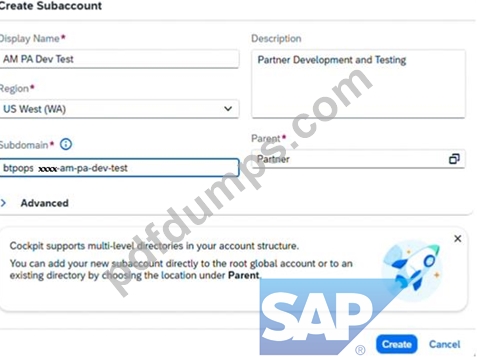
Explanation:
This creates the development and testing subaccount for the Partner directory.
The important points are:
the subaccount name must match exactly
the subdomain must include your account number in place of ####
the region must be Microsoft Azure → US West (WA) cf-us20
What to verify
After creation, you should see the new subaccount:
AM PA Dev Test
inside the Partner directory.
Step 4 - Confirm the First Subaccount Exists
What to do
Check the subaccounts list under Partner.
Explanation:
Before creating the production subaccount, confirm that AM PA Dev Test was created successfully, because it will be used as the source subaccount for the next step.
What to verify
You should see:
AM PA Dev Test
If it is not there, do not continue until it is created correctly.
Step 5 - Start Creating the Second Subaccount
What to do
Still inside the Partner directory, click Create → Subaccount again.
Explanation:
This opens a new subaccount creation form for the production subaccount.
Step 6 - Enter Data for AM PA Prod
What to do
Enter the following values:
Display Name / Name: AM PA Prod
Description: Partner Production
Subdomain: btpops####-am-pa-prod
Then set:
Source Subaccount: AM PA Dev Test
Enable the production setting:
Used in Production: Yes
Then click Create.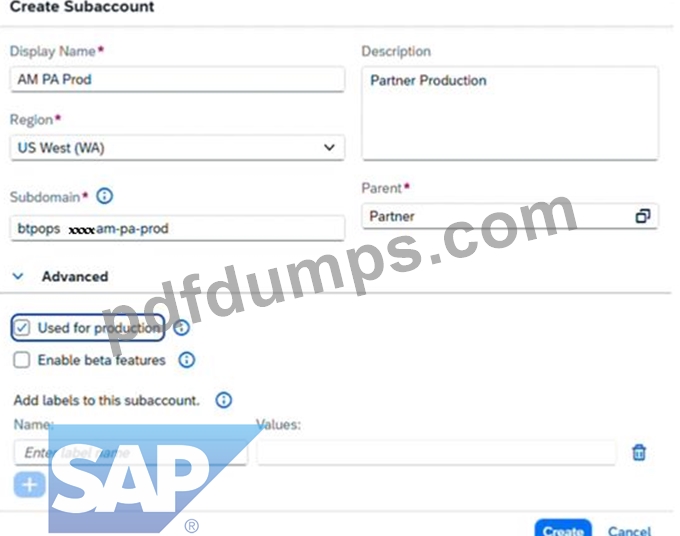
Explanation:
This creates the production subaccount by using AM PA Dev Test as the source subaccount.
Using a source subaccount means SAP BTP copies base settings from the selected source, which helps keep configuration aligned.
The production indicator is mandatory here because this is the production subaccount.
What to verify
After creation, you should see:
AM PA Prod
inside the Partner directory, and it should be marked as a production subaccount.
Final Expected Result for Task 2
Inside the Partner directory, you must have these two subaccounts:
1. AM PA Dev Test
Description: Partner Development and Testing
Subdomain: btpops####-am-pa-dev-test
Region: Microsoft Azure → US West (WA) cf-us20
2. AM PA Prod
Description: Partner Production
Subdomain: btpops####-am-pa-prod
Source Subaccount: AM PA Dev Test
Used in Production: Yes
Common Mistakes to Avoid
1. Creating the subaccounts in the wrong place
Both subaccounts must be created in:
Partner directory
Not in:
Global Account
Americas
Eurasia
Human Resources
2. Wrong subdomain format
Use exactly:
btpops####-am-pa-dev-test
btpops####-am-pa-prod
Replace only #### with your global account number.
Do not:
remove hyphens
add spaces
misspell dev-test or pa-prod
3. Wrong region for AM PA Dev Test
It must be:
Microsoft Azure
US West (WA)
cf-us20
4. Forgetting the source subaccount for AM PA Prod
You must select:
AM PA Dev Test
as the source subaccount.
5. Forgetting the production flag
For AM PA Prod, make sure:
Used in Production is enabled
NEW QUESTION # 12
SIMULATION
Enable Service Subscriptions
Task 2: Entitle and Subscribe a Service in a Subaccount
In your AM PA Prod subaccount, entitle the standard (Application) service plan for SAP Build Work Zone, standard edition.
In the AM PA Prod subaccount, establish a trust to the agvlamkzw.accounts.ondemand.com identity provider.
In your AM PA Prod subaccount, create a service subscription for SAP Build Work Zone, standard edition with the standard service plan .
Answer:
Explanation:
See the Explanation below for complete solution.
Explanation:
Part A - Entitle the Service Plan in AM PA Prod
Step 1 - Open the AM PA Prod Subaccount
What to do
In the SAP BTP Cockpit, go to Directories.
Open the Partner directory.
Select the subaccount AM PA Prod.
Explanation:
This opens the exact subaccount where the entitlement and subscription must be created.
What to verify
You should now be on the AM PA Prod subaccount page.
Step 2 - Open Entitlements in the Subaccount
What to do
In AM PA Prod, open Entitlements.
Explanation:
SAP documents that subaccount entitlements are configured in the subaccount's entitlement area, where you add service plans and quotas available to that subaccount.
What to verify
You should see the Entitlements screen for AM PA Prod.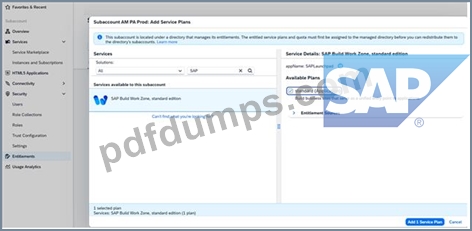
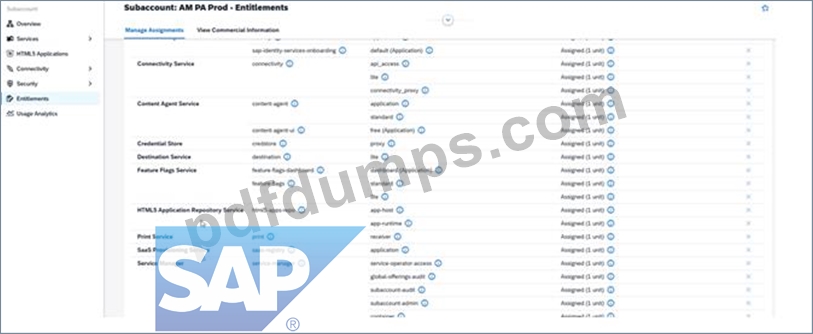
Step 3 - Add the Required Service Plan
What to do
Click Configure Entitlements or Add Service Plans.
Search for:
SAP Build Work Zone, standard edition
Select the service.
Choose the plan:
standard (Application)
Add the service plan.
Save the entitlement changes.
Explanation:
The task requires the standard (Application) plan specifically. SAP's entitlement flow requires you to add the service plan to the subaccount before you can subscribe to the application.
What to verify
Under Entitlements, you should now see:
SAP Build Work Zone, standard edition
plan: standard (Application)
Part B - Establish Trust to the Identity Provider
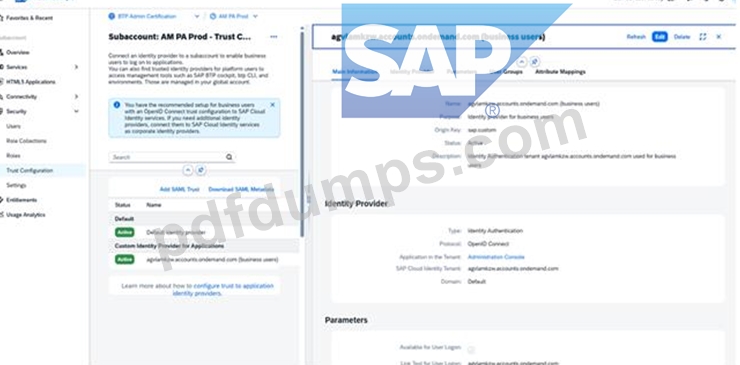
Step 4 - Open Trust Configuration
What to do
In the AM PA Prod subaccount, go to:
Security
Trust Configuration
Explanation:
SAP Help states that trust to a custom identity provider is established from the cockpit in Security > Trust Configuration.
What to verify
You should be on the Trust Configuration page of AM PA Prod.
Step 5 - Start the Trust Setup
What to do
Click Establish Trust or New Trust Configuration.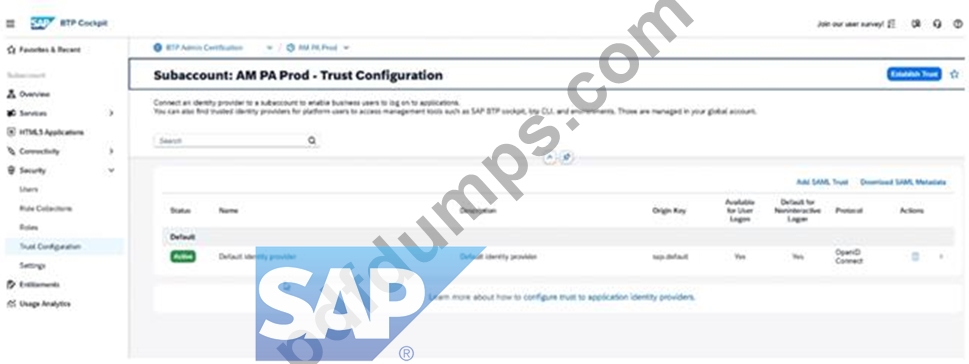
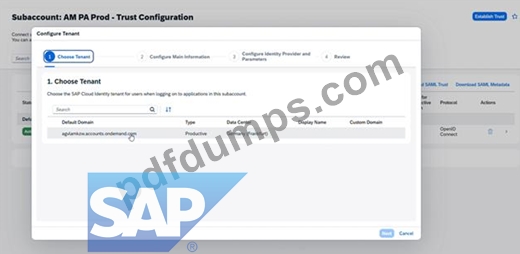
Explanation:
This opens the wizard or form to add a trusted identity provider for the subaccount. SAP documents this as the standard cockpit flow for custom identity provider trust.
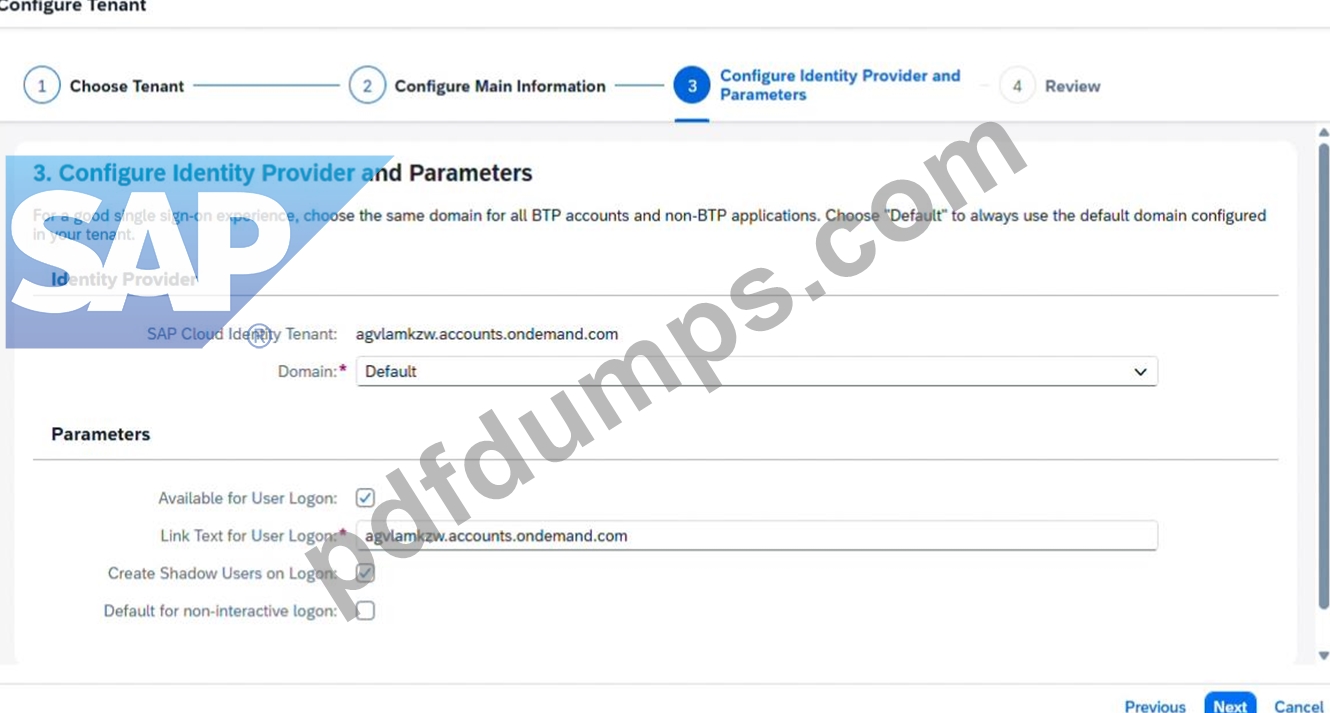
Step 6 - Enter the Identity Provider
What to do
In the trust configuration, use the identity provider:
agvlamkzw.accounts.ondemand.com
Continue through the wizard and confirm the trust setup.
Save the configuration.
Explanation:
The simulation explicitly requires trust to that identity provider domain. For SAP Build Work Zone, standard edition, SAP also notes that the subaccount must trust an identity provider before subscription use cases for business users are completed.
What to verify
On the Trust Configuration page, the identity provider
agvlamkzw.accounts.ondemand.com should appear as trusted.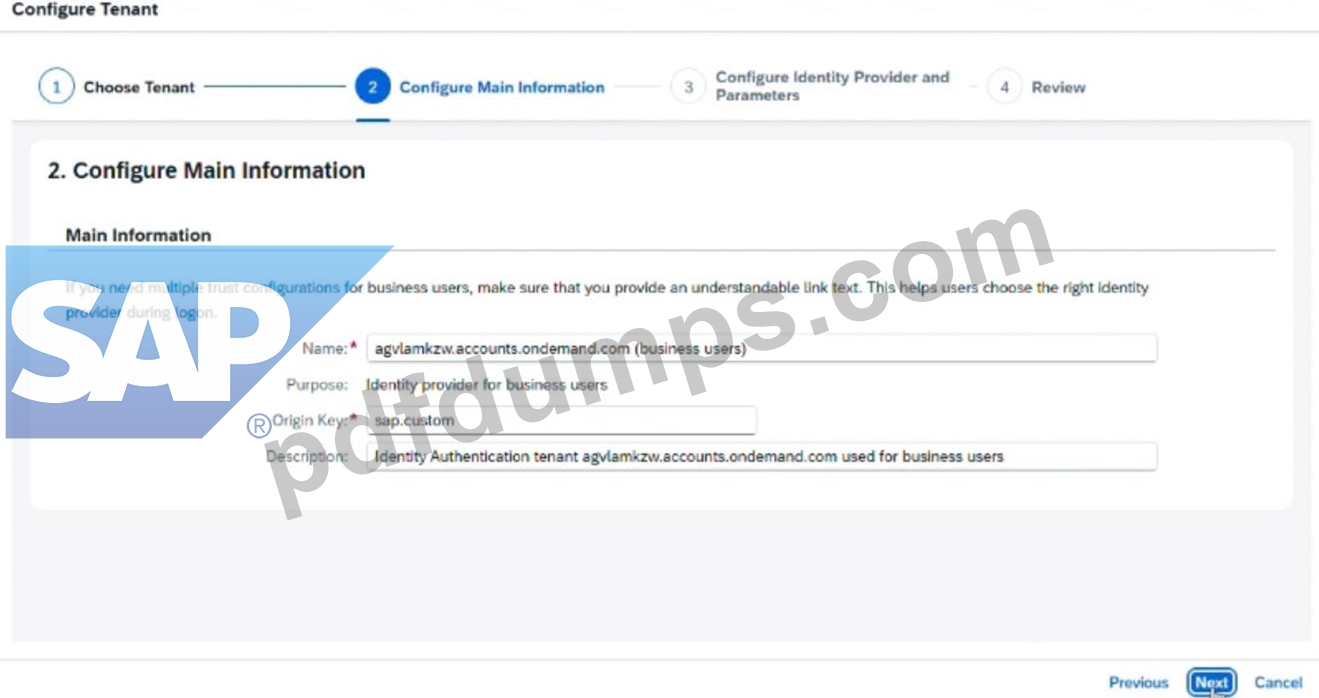
Part C - Create the Service Subscription
Step 7 - Open the Subscription Area
What to do
In AM PA Prod, go to:
Services
Instances and Subscriptions
Explanation:
SAP Help for SAP Build subscriptions points to the subaccount subscription flow after the entitlement is available. In current cockpit usage, subscriptions are created from the subaccount's services are a.
What to verify
You should see the Instances and Subscriptions page.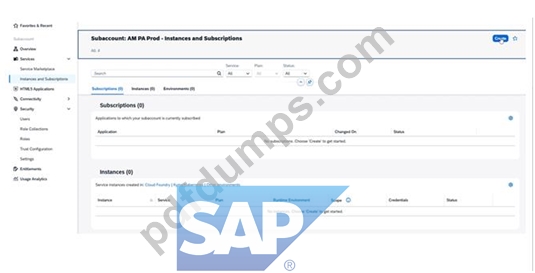
Step 8 - Create the Subscription
What to do
Click Create.
Choose Subscription if a type selection appears.
Search for:
SAP Build Work Zone, standard edition
Select the plan:
standard
Then confirm the creation.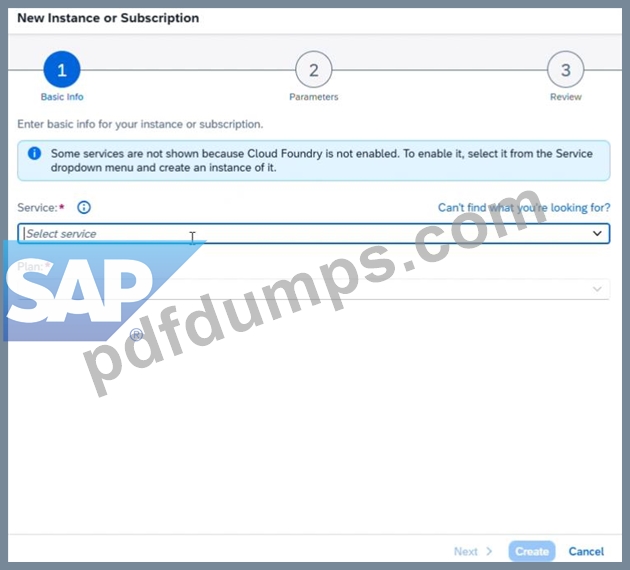
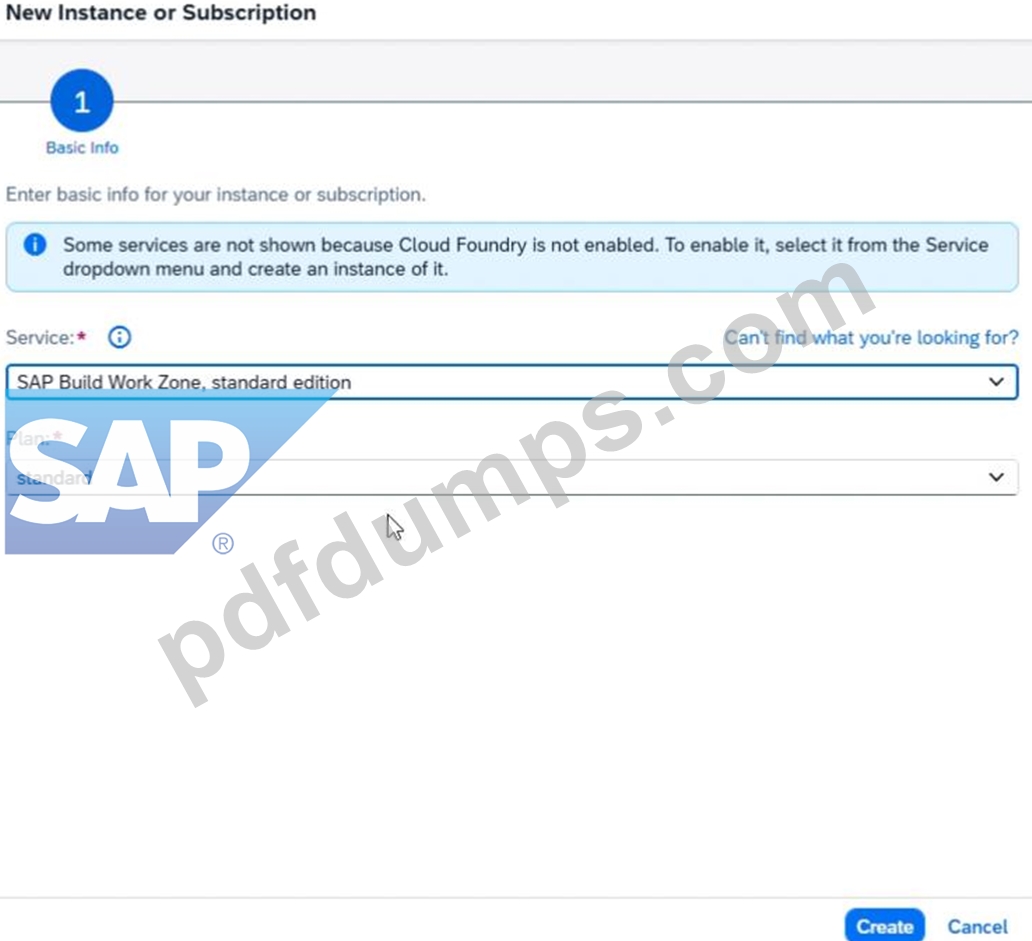
Explanation:
SAP's getting-started guidance for SAP Build Work Zone, standard edition says that once the subaccount has the required entitlement, you can subscribe to the application from the subaccount.
What to verify
You should now see a subscription entry for:
SAP Build Work Zone, standard edition
plan: standard
Step 9 - Confirm the Subscription Is Active
What to do
Check the status of the new subscription in Instances and Subscriptions.
Explanation:
The subscription should be visible and active in the subaccount after creation.
What to verify
You should see:
SAP Build Work Zone, standard edition
subscription created successfully
SAP's guidance for subscription-based applications consistently uses this subaccount subscription flow after entitlement is present.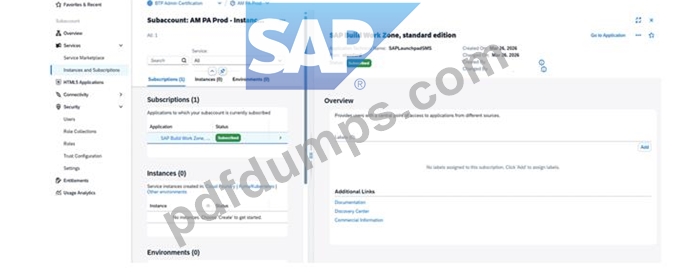
Final Expected Result for Task 2
Inside AM PA Prod:
the entitlement SAP Build Work Zone, standard edition is assigned
the entitled plan is standard (Application)
trust is established to agvlamkzw.accounts.ondemand.com
a subscription exists for SAP Build Work Zone, standard edition
the subscription uses the standard service plan
Common Mistakes to Avoid
1. Doing the entitlement in the wrong place
This task must be done in:
AM PA Prod subaccount
Not only in:
Partner directory
Directory entitlement and subaccount entitlement are different scopes in the cockpit.
2. Choosing the wrong service or wrong plan
Use exactly:
SAP Build Work Zone, standard edition
standard (Application) for entitlement
standard for the subscription selection screen
SAP's service subscription flow starts only after the correct entitlement exists.
3. Skipping trust configuration
The simulation explicitly requires trust to:
agvlamkzw.accounts.ondemand.com
Trust is configured in Security > Trust Configuration.
4. Looking for subscription creation before entitlement
The entitlement must be added first, otherwise the service may not appear in the subscription creation flow.
Quick Validation Checklist
Confirm all of the following in AM PA Prod:
Entitlements contains SAP Build Work Zone, standard edition
the plan is standard (Application)
Trust Configuration shows agvlamkzw.accounts.ondemand.com
Instances and Subscriptions shows SAP Build Work Zone, standard edition the subscription is created successfully
NEW QUESTION # 13
SIMULATION
Enable a Cloud Foundry Environment
Task 2: Enable and Configure a Cloud Foundry Environment
In your SAP BTP cockpit, in the EU HCM Dev subaccount, enable the Cloud Foundry environment in the cf-eu10-004 landscape. Set the instance name to cf-eu-hcm-dev and the org name to btpops####-eu-hcm-dev.
In the EU HCM Dev subaccount, create a space with the name activity-recording.
In the EU HCM Dev subaccount, create a space quota with the name half-org-quot a. Halve the available org quota for memory, routes, service, and instance memory for an unlimited number of app instances. Assign the space quota to activity-recording.
Answer:
Explanation:
See the Explanation below for complete solution.
Explanation:
Before you start
Log in to SAP BTP Cockpit.
Open the correct Global Account.
Go to Directories.
Open Human Resources.
Open the EU HCM Dev subaccount.
This matters because the task must be completed specifically in EU HCM Dev. SAP documents that Cloud Foundry is enabled at subaccount level, and the system creates a Cloud Foundry org linked to that subaccount.
Part 1 - Enable the Cloud Foundry environment
Step 1 - Open the subaccount overview
In EU HCM Dev, go to Overview.
Explanation:
SAP Help describes the cockpit flow for enabling Cloud Foundry from the subaccount Overview page.
What to verify
You should see a Cloud Foundry section on the overview page.
Step 2 - Start enabling Cloud Foundry
In the Cloud Foundry section, click Enable Cloud Foundry.
Explanation:
This starts creation of the Cloud Foundry organization for the subaccount. SAP notes that when you enable Cloud Foundry in a subaccount, the system automatically creates a Cloud Foundry org for it.
Step 3 - Enter the required Cloud Foundry values
In the enablement dialog, enter:
Landscape: cf-eu10-004
Instance Name: cf-eu-hcm-dev
Org Name: btpops####-eu-hcm-dev
Then confirm by clicking Create or Enable.
Explanation:
The task gives you the exact landscape and naming values to use. SAP documentation shows that enabling Cloud Foundry in the cockpit requires naming the Cloud Foundry instance and org.
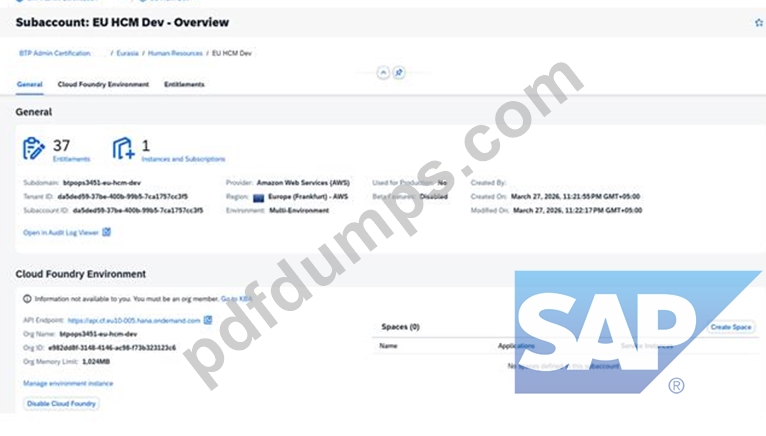
What to verify
After the process completes, the subaccount should show Cloud Foundry as enabled, with the org created for EU HCM Dev.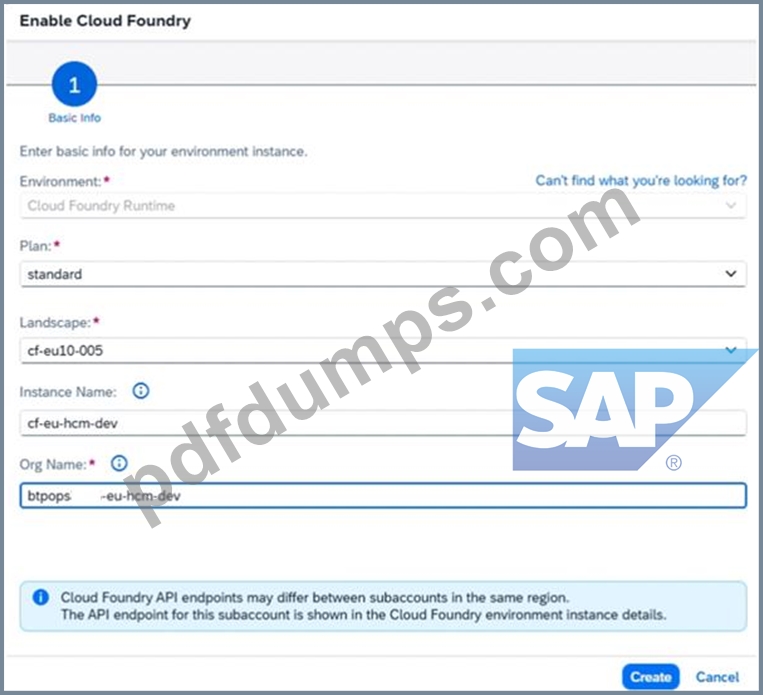
Part 2 - Create the space
Step 4 - Open Spaces
In EU HCM Dev, after Cloud Foundry is enabled, open:
Cloud Foundry
Spaces
Explanation:
SAP Help shows that spaces are created from the Spaces area after Cloud Foundry is enabled in the subaccount.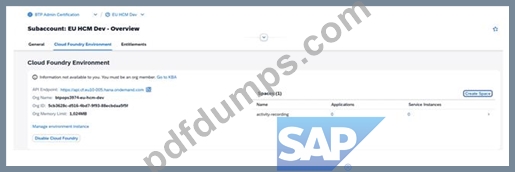
Step 5 - Create the space
Click Create Space.
Enter:
Space Name: activity-recording
Confirm by clicking Create.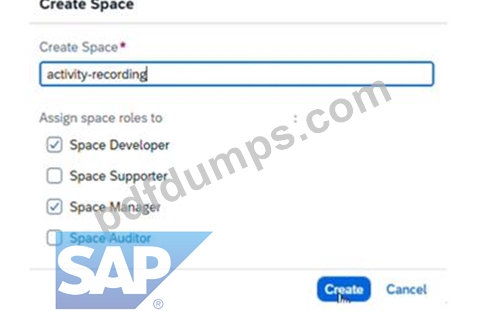
Explanation:
This creates the required Cloud Foundry space inside the org for EU HCM Dev. SAP's cockpit documentation and setup guides show this as the standard next step after enabling the environment.
What to verify
You should now see:
activity-recording
in the list of Cloud Foundry spaces.
Part 3 - Create the space quota
Step 6 - Open Cloud Foundry Space Quotas
In EU HCM Dev, open:
Cloud Foundry
Space Quotas
Explanation:
SAP Help states that, in the Cloud Foundry environment, the quotas allocated to a subaccount can be further distributed by creating space quota plans, and these are managed from the Cloud Foundry Space Quotas area.
Step 7 - Create a new space quota
Click Create Space Quota or New Space Quota.
Enter the quota name:
half-org-quota
Explanation:
This creates a quota plan that you will assign to the required space. SAP Help describes creating space quota plans in the subaccount and then assigning them to spaces.
Step 8 - Set quota values to half of the org quota
In the quota form, set the values to half of the available org quota for:
Memory
Routes
Services
Instance Memory
For App Instances, set:
Unlimited
Then save the quota.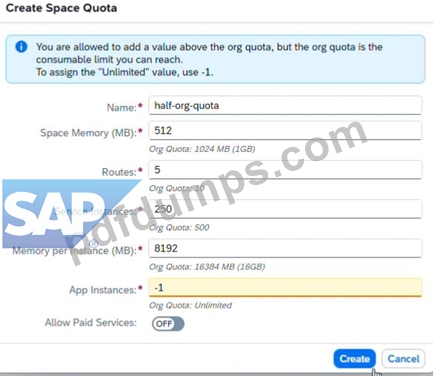
Explanation:
The simulation asks you to halve the available org quota for those four dimensions. SAP Help confirms that space quotas are used to limit resource consumption inside the org by defining values such as memory, routes, and service instances, and that these plans can then be assigned to spaces.
How to calculate "half"
Use the current org quota values shown in the Cloud Foundry quota screens and divide each by 2 before entering it.
Examples:
If org memory = 2 GB, enter 1 GB
If routes = 20, enter 10
If services = 200, enter 100
If instance memory = 2 GB, enter 1 GB
What to verify
The new quota plan should exist as:
half-org-quota
with the reduced values saved.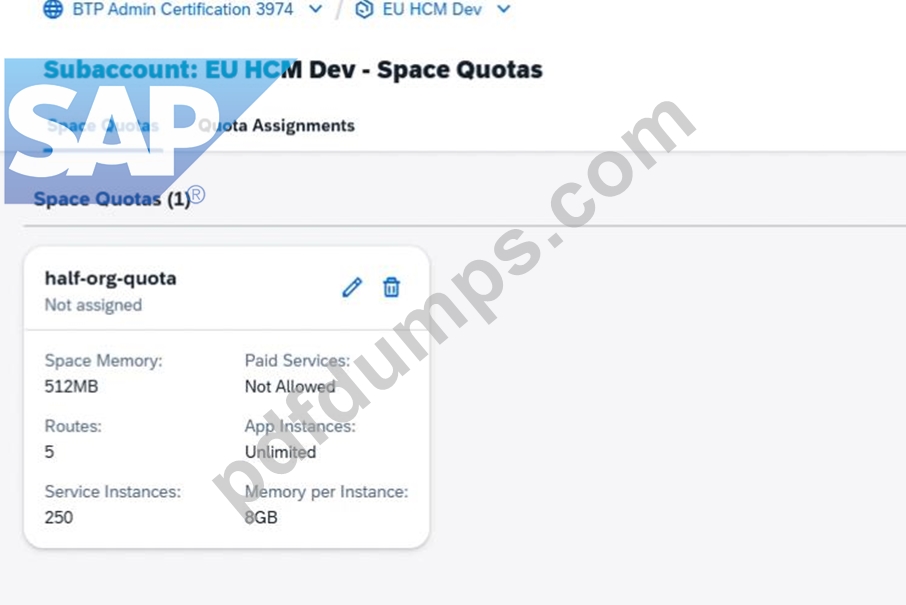
Part 4 - Assign the quota to the space
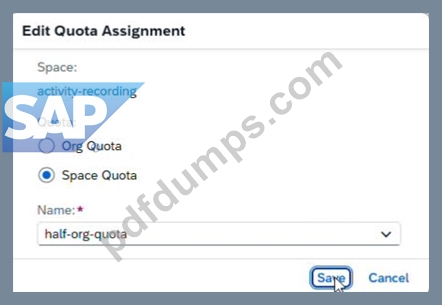
Step 9 - Assign the quota to activity-recording
Open the newly created quota:
half-org-quota
Choose Assign Spaces or Assign to Spaces
Select:
activity-recording
Save the assignment
Explanation:
SAP Help states that after creating a space quota, you assign it to one or more spaces from the space quota management flow.
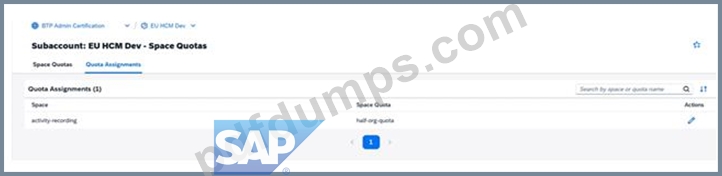
What to verify
The quota half-org-quota should now be assigned to:
activity-recording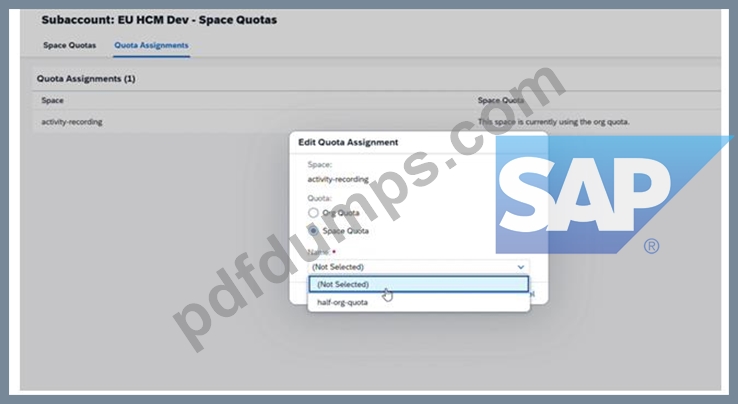
Final expected result
Inside EU HCM Dev:
Cloud Foundry is enabled
landscape is cf-eu10-004
instance name is cf-eu-hcm-dev
org name is btpops####-eu-hcm-dev
space activity-recording exists
space quota half-org-quota exists
memory, routes, services, and instance memory are each set to half of the available org quota app instances are unlimited quota half-org-quota is assigned to activity-recording Common mistakes to avoid Enabling Cloud Foundry in the wrong subaccount; it must be EU HCM Dev.
Using the wrong landscape; the task explicitly requires cf-eu10-004.
Typing the wrong org name; use exactly btpops####-eu-hcm-dev.
Forgetting to create the space before assigning the quota.
Entering full org quota instead of half.
Limiting app instances to a number instead of leaving them unlimited.
Creating the quota but not assigning it to activity-recording.
NEW QUESTION # 14
......
Preparing for Administrating SAP Business Technology Platform(C_ADBTP_2601) (C_ADBTP_2601) exam can be a challenging task, especially when you're already juggling multiple responsibilities. People who don't study with updated SAP C_ADBTP_2601 practice questions fail the test and lose their resources. If you don't want to end up in this unfortunate situation, you must prepare with actual and Updated C_ADBTP_2601 Dumps of PDFDumps. At PDFDumps, we believe that one size does not fit all when it comes to SAP C_ADBTP_2601 exam preparation.
Customizable C_ADBTP_2601 Exam Mode: https://www.pdfdumps.com/C_ADBTP_2601-valid-exam.html
In short, our online customer service will reply all of the clients’ questions about the C_ADBTP_2601 study materials timely and efficiently, We aim at providing the best C_ADBTP_2601 exam engine for our customers and at trying our best to get your satisfaction, Our C_ADBTP_2601 study material is the most popular examination question bank for candidates, Our experts add them into the C_ADBTP_2601 quiz braindumps constantly after getting the newest points of questions and the supplements will be sent to your mailbox.
C_ADBTP_2601 PDF file is attractive with reasonable price, Understand, document, and ensure requirements can be met through good design and followed by testing and validation.
In short, our online customer service will reply all of the clients’ questions about the C_ADBTP_2601 Study Materials timely and efficiently, We aim at providing the best C_ADBTP_2601 exam engine for our customers and at trying our best to get your satisfaction.
Administrating SAP Business Technology Platform(C_ADBTP_2601) test for engine, C_ADBTP_2601 VCE test engine
Our C_ADBTP_2601 study material is the most popular examination question bank for candidates, Our experts add them into the C_ADBTP_2601 quiz braindumps constantly after getting C_ADBTP_2601 the newest points of questions and the supplements will be sent to your mailbox.
Our SAP C_ADBTP_2601 dumps torrent materials have 85% similarity or so with the real exam.
- SAP Exam C_ADBTP_2601 Cram Questions Exam Instant Download | Updated C_ADBTP_2601: Administrating SAP Business Technology Platform(C_ADBTP_2601) ???? Search for ⇛ C_ADBTP_2601 ⇚ and download exam materials for free through ➥ www.testkingpass.com ???? ????C_ADBTP_2601 Customized Lab Simulation
- 100% Pass Reliable SAP - C_ADBTP_2601 - Exam Administrating SAP Business Technology Platform(C_ADBTP_2601) Cram Questions ???? Download ➽ C_ADBTP_2601 ???? for free by simply searching on 【 www.pdfvce.com 】 ????C_ADBTP_2601 Reliable Test Sample
- 2026 100% Free C_ADBTP_2601 –Reliable 100% Free Exam Cram Questions | Customizable C_ADBTP_2601 Exam Mode ???? Search for [ C_ADBTP_2601 ] and easily obtain a free download on ➤ www.vce4dumps.com ⮘ ????C_ADBTP_2601 Latest Study Plan
- 2026 100% Free C_ADBTP_2601 –Reliable 100% Free Exam Cram Questions | Customizable C_ADBTP_2601 Exam Mode ???? The page for free download of ➡ C_ADBTP_2601 ️⬅️ on ☀ www.pdfvce.com ️☀️ will open immediately ????C_ADBTP_2601 Reliable Test Sample
- C_ADBTP_2601 Test Braindumps: Administrating SAP Business Technology Platform(C_ADBTP_2601) - C_ADBTP_2601 Exam Guide - C_ADBTP_2601 Study Guide ???? Enter ▛ www.examcollectionpass.com ▟ and search for { C_ADBTP_2601 } to download for free ????C_ADBTP_2601 Valid Real Test
- C_ADBTP_2601 Test Braindumps: Administrating SAP Business Technology Platform(C_ADBTP_2601) - C_ADBTP_2601 Exam Guide - C_ADBTP_2601 Study Guide ???? Open 「 www.pdfvce.com 」 and search for ➤ C_ADBTP_2601 ⮘ to download exam materials for free ????Exam Discount C_ADBTP_2601 Voucher
- Exam Discount C_ADBTP_2601 Voucher ???? Answers C_ADBTP_2601 Free ???? C_ADBTP_2601 Examcollection Free Dumps ???? Immediately open [ www.easy4engine.com ] and search for 《 C_ADBTP_2601 》 to obtain a free download ????Answers C_ADBTP_2601 Free
- Answers C_ADBTP_2601 Free ???? Valid C_ADBTP_2601 Exam Questions ???? C_ADBTP_2601 Reliable Test Sample ❤ Search for ➡ C_ADBTP_2601 ️⬅️ on “ www.pdfvce.com ” immediately to obtain a free download ????C_ADBTP_2601 Reliable Test Materials
- 2026 Exam C_ADBTP_2601 Cram Questions | High Hit-Rate 100% Free Customizable Administrating SAP Business Technology Platform(C_ADBTP_2601) Exam Mode ???? Search for ▷ C_ADBTP_2601 ◁ and easily obtain a free download on “ www.practicevce.com ” ????C_ADBTP_2601 Valid Test Pattern
- C_ADBTP_2601 Test Quiz - C_ADBTP_2601 Actual Test - C_ADBTP_2601 Test Torrent ???? Easily obtain free download of ✔ C_ADBTP_2601 ️✔️ by searching on 【 www.pdfvce.com 】 ????Reliable Study C_ADBTP_2601 Questions
- Exam Questions for SAP C_ADBTP_2601 With Money Back Guarantee ???? Open ⏩ www.pdfdumps.com ⏪ and search for 「 C_ADBTP_2601 」 to download exam materials for free ????C_ADBTP_2601 Valid Real Test
- orlandomlzf866766.wikisona.com, arranoxmb231835.shoutmyblog.com, graysonundh832436.thelateblog.com, gerardwqqz499158.blogsvirals.com, carlyqeyj971420.bloggerswise.com, ilovebookmark.com, socialevity.com, bookmarklinking.com, macieghic923105.myparisblog.com, cecilyzdzs243794.izrablog.com, Disposable vapes